Trump’s Plan to Defund the NIH Will Ruin a National Treasure
Trump, Musk, and Vought are purging institutions and cutting off access to educational and research opportunities for anyone who isn’t straight and white.
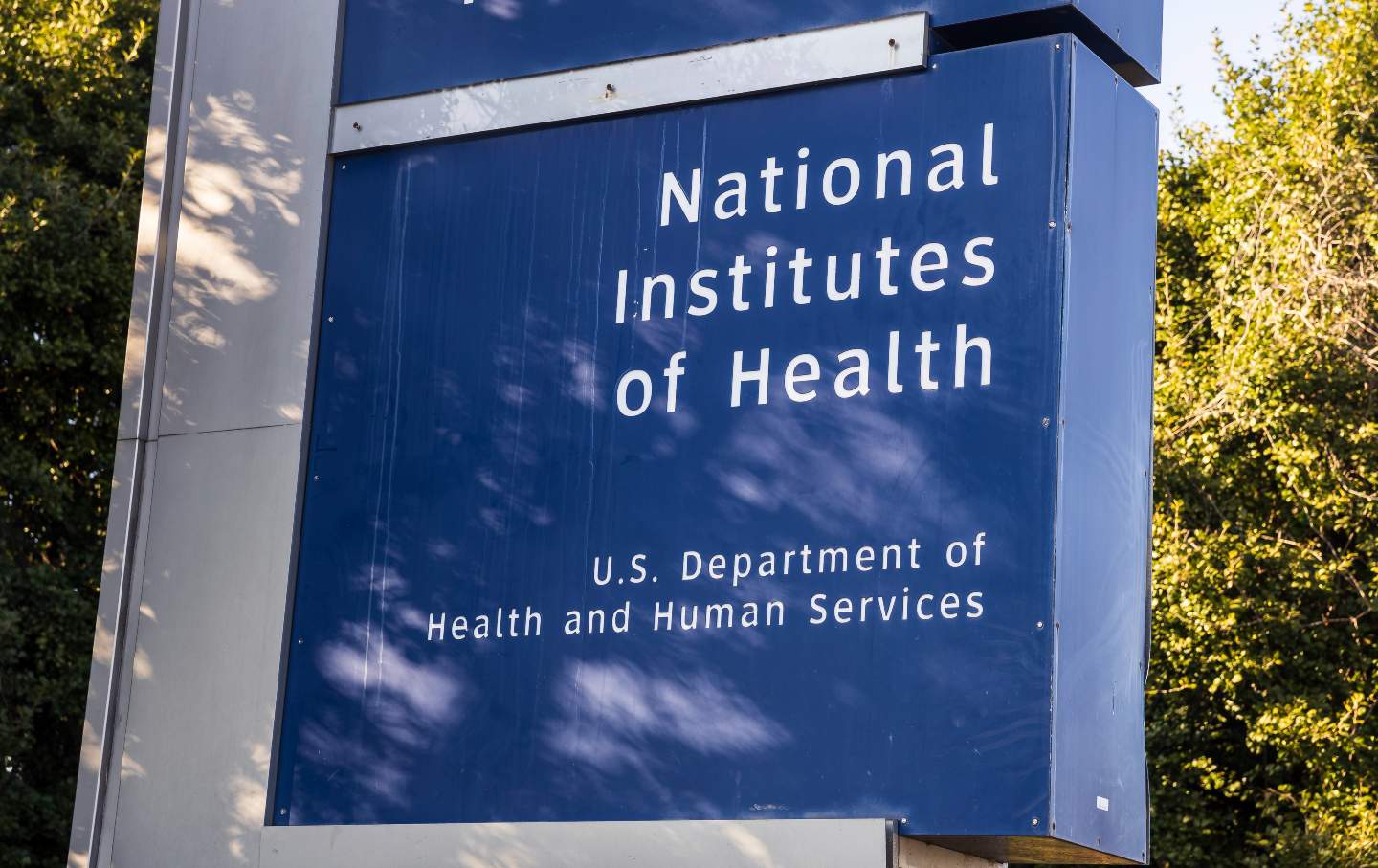
A sign is seen outside National Institutes of Health headquarters in Bethesda, Maryland.
(Frances Chung / AP Images)
The United States has been a leader in biomedical research for decades. Drugs, vaccines, and diagnostics that have been developed through research funded by the National Institutes of Health (NIH) has extended the lives of millions of people both here and around the world. The economic benefits of the national investment in biomedical research flow down to local communities in jobs and businesses that support the vast infrastructure needed to do this work. By some estimates in the fiscal year 2023, NIH funding created over 400,000 jobs across the US and pumped $92 billion into towns and cities across the country. And the US has been a beacon for scientists globally—millions of people come here to study—some to stay when they are done, some to return home to build their own countries’ research ecosystems.
In a little over three weeks, Donald Trump, Elon Musk, and Russell Vought will destroy this national treasure. Their plan is to attack the NIH with deep ideological motives in order to root out any focus on anyone other than white people and to shrink the agency—so that, in the words of Grover Norquist, “it is small enough to drown in the bathtub.” The earliest moves made against the NIH, in late January, were meant to destabilize the system: The administration froze grant funding, banned communication from agency employees, and made a list of forbidden terms that were to be applied to grants and contracts. Then, in early February came the hammer—the NIH issued a non-legal edict that cut indirect costs to universities to 15 percent. Let me explain what I think is going on.
First, let’s talk about “slave state” science. While Trump, Musk, and Vought would call the alternative “woke” science, let’s be clear about what this really is. If you are banning terms that refer to race, ethnicity, gender, sexuality, and words like “equity” from grants, you are building a white supremacist architecture for science in the United States. We ignored the health disparities. facing black and brown Americans, women, and LGBTQ people for years There are plenty of books to read about that sordid history. But in the late 20th century, the NIH and federal agencies pivoted to address these fundamental gaps in life expectancy and healthcare outcomes. By forbidding a focus on all this now, you’re simply saying the health of anyone but white and straight people, and mostly men, does not matter. This is science that would make Jefferson Davis proud. It’s eugenics for the 21st century.
In purging mention of these terms in hiring, under the guise of going after diversity, equity, and inclusion programs, Trump, Musk, and Vought are purging institutions and cutting off access to educational and research opportunities for anyone who isn’t straight and white. The NIH has gutted its DEI programs, and other institutions like the Howard Hughes Medical Institute are following suit. What does that mean?
It means the door is being shut in the face of people who have been historically underrepresented in research, despite their talents. (And let’s nip the BS about wanting a color-blind system based on merit, because we know what this is about, too.) Eduardo Bonilla-Silva at Duke has talked about color-blind racism, in which the overt racism “Bull Connor”–style has been replaced by systemic practices to disenfranchise people. The data on continuing discrimination in the labor market, in access to education is there for all to see, even if Trump and Co. want to distract you from it. What we will have left is a system of research for and by white people in America.
Now, for the coup de grâce. In February, MAGA Matthew J. Memoli, the acting director of NIH, sent out a notice on a Friday night that the government would cut indirect costs to universities to 15 percent from a previous average of about 30 percent, though that’s even a higher percentage for other institutions like Harvard, Johns Hopkins and Stanford. Trump, Musk, and Vought tried to spin this as cost-savings and a redirection of resources to “real” research rather than to “woke” university bureaucracies. But every working scientist knows that these indirect costs pay to keep the lights on and far more than that. IDCs as they are known, undergird the support for research that doesn’t come from the direct payments to scientists—IDCs pay for administrators who help us with preparing and processing grants, keeping up animal facilities and lab safety programs, equipment that is shared among many at an institution, among other things.
But what Trump, Musk, and Vought know is that IDCs are vital to universities, part of their fiscal model, and without them or with cuts as savage as this, many universities will teeter on the edge. This has nothing to do with efficiency or cost-cutting—this is the way in which the administration can kneecap higher education. Remember, JD Vance gave a speech at the National Conservatism Conference in 2021 called “Universities are the Enemy.” The cuts to IDCs for this purpose are also discussed in the blueprint for Project 2025. As my Yale colleague Jason Stanley wrote in his new book Erasing History, authoritarians go after universities to bring them to heel or to control them—because if they are to rewrite history, as in this case of a whitewashed America, they cannot have dissent and independent thinking getting in their way.
What is happening right now is not irreversible, but it has inflicted a wound on biomedical research that will already take decades to recover from. It will hurt people; it will slow progress on cures and treatments for diseases, put many around the country on the unemployment line, and rob communities of the economic investments that NIH funding brings to them. I expect to see a brain drain, fewer people coming here to study and to do research, and also for some American scientists looking for greener pastures to move to Europe and Asia.
In their ideological crusade, Trump, Musk, and Vought are killing the goose that laid the golden egg of American predominance in biomedical research that took over a half a century to build. And they may kill more than that by stymying research on cancer, infectious pathogens, cardiovascular disease, dementia—and perhaps on all diseases and conditions across the NIH’s portfolio.
Disobey authoritarians, support The Nation
Over the past year you’ve read Nation writers like Elie Mystal, Kaveh Akbar, John Nichols, Joan Walsh, Bryce Covert, Dave Zirin, Jeet Heer, Michael T. Klare, Katha Pollitt, Amy Littlefield, Gregg Gonsalves, and Sasha Abramsky take on the Trump family’s corruption, set the record straight about Robert F. Kennedy Jr.’s catastrophic Make America Healthy Again movement, survey the fallout and human cost of the DOGE wrecking ball, anticipate the Supreme Court’s dangerous antidemocratic rulings, and amplify successful tactics of resistance on the streets and in Congress.
We publish these stories because when members of our communities are being abducted, household debt is climbing, and AI data centers are causing water and electricity shortages, we have a duty as journalists to do all we can to inform the public.
In 2026, our aim is to do more than ever before—but we need your support to make that happen.
Through December 31, a generous donor will match all donations up to $75,000. That means that your contribution will be doubled, dollar for dollar. If we hit the full match, we’ll be starting 2026 with $150,000 to invest in the stories that impact real people’s lives—the kinds of stories that billionaire-owned, corporate-backed outlets aren’t covering.
With your support, our team will publish major stories that the president and his allies won’t want you to read. We’ll cover the emerging military-tech industrial complex and matters of war, peace, and surveillance, as well as the affordability crisis, hunger, housing, healthcare, the environment, attacks on reproductive rights, and much more. At the same time, we’ll imagine alternatives to Trumpian rule and uplift efforts to create a better world, here and now.
While your gift has twice the impact, I’m asking you to support The Nation with a donation today. You’ll empower the journalists, editors, and fact-checkers best equipped to hold this authoritarian administration to account.
I hope you won’t miss this moment—donate to The Nation today.
Onward,
Katrina vanden Heuvel
Editor and publisher, The Nation